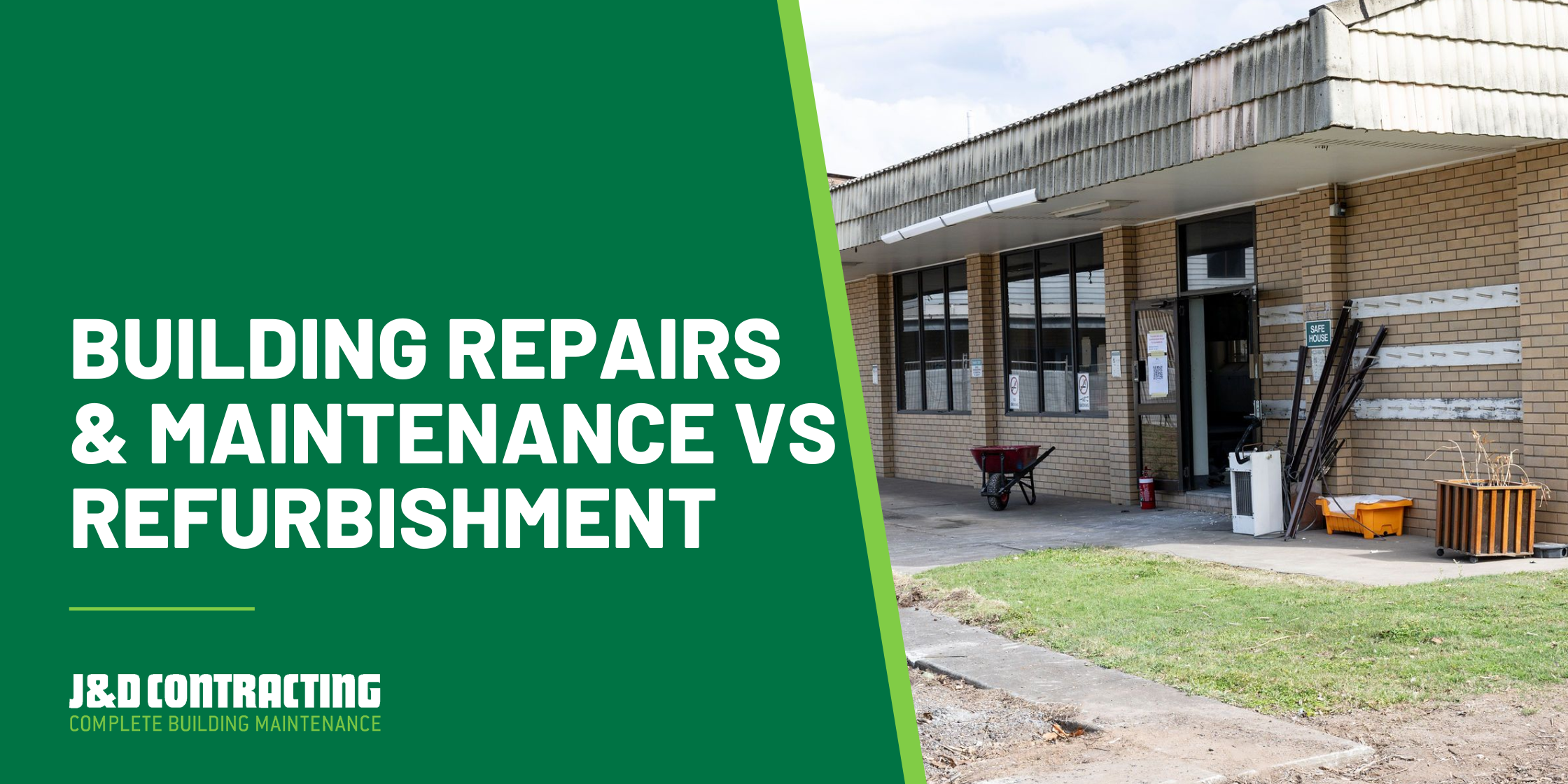
When it comes to building repairs and maintenance vs refurbishment, the wrong call here costs more than the job itself. Approving repairs when refurbishment was needed is common mistakes made, costing time and money when a refurbishment should have been the first course of action. Commissioning a full refurbishment when targeted repairs or maintenance would have done the job and saving the business time and money.
Budget pressures, tenant expectations, safety obligations, and long-term asset strategy all push in different directions. This guide gives you a practical framework to cut through that noise, with indicative cost benchmarks and honest guidance on when each option makes the most sense.
Not sure which path suits your building? Contact J&D Contracting for an obligation-free condition assessment.
Defining building repairs, maintenance, and refurbishments
Building repairs and maintenance refers to targeted work that restores a specific element of your building to its functional condition. Think crack injection in a concrete column, repointing deteriorated mortar, patching a localised waterproofing failure, or repairing a damaged facade panel.
Repairs address the symptom and correct that symptom. They are designed to stabilise a defect, extend the life of an existing system, and prevent further deterioration without replacing the underlying structure or system wholesale.
Building refurbishment is a broader scope of works that replaces, upgrades, or renews one or more building systems, elements, or facades. It addresses root causes rather than surface symptoms, and it typically delivers a significant improvement in performance, presentation, and longevity.
A commercial building refurbishment programme might include full facade renewal, replacement of end-of-life waterproofing membranes, structural remediation across multiple elements, or a staged upgrade of building envelope systems over one to three years.
Importantly, refurbishment does not have to happen all at once. A staged approach, where works are phased across budget cycles, can make refurbishment financially accessible wh tile minimising tenant disruption. We cover this in more detail below.
A practical decision framework: repair/maintain or refurbish?
Use these four criteria to assess your situation. Where multiple criteria point in the same direction, your path becomes clearer. Where they conflict, safety and compliance should always take priority.
1. Cost assessment
The core financial question is not the upfront cost of the repair, but the total cost over time.
A targeted waterproofing repair might cost $8,000 to $25,000. A full membrane replacement for the same area might run $60,000 to $150,000 or more. On face value, the repair wins. But if that repair fails within two years and the underlying membrane continues to degrade, you may spend $30,000 to $50,000 in repeated interventions before eventually funding the membrane replacement anyway, at a higher cost than if you had acted earlier.
A useful threshold: when your annualised building repairs and maintenance spend exceeds 1.5 to 2% of your asset value per year, the cumulative case for refurbishment typically becomes compelling. At that point, you are spending heavily to maintain a declining position rather than investing to improve one.
2. Risk and safety
Some defects remove budget from the equation entirely.
Safety-critical defects in commercial buildings include spalling concrete near entry points, facade delamination that creates falling hazard risk, structural cracking affecting load-bearing elements, and waterproofing failures adjacent to electrical systems.
Under Australian building codes and standards including the National Construction Code and state-based Work Health and Safety legislation, building owners carry a duty of care to occupants, visitors, and the public. Knowingly deferring action on a safety-related defect creates significant liability exposure. A properly conducted condition assessment documents the risk profile of your building in a format that protects you legally, regardless of which path you ultimately take.
If a defect has any safety dimension, treat it as a non-negotiable.
3. Longevity
How long will the intervention actually last?
Indicative lifespans for common repair types:
- Surface coating repairs: 3 to 7 years
- Crack injection and localised concrete repairs: 5 to 10 years, depending on root cause
- Facade repointing: 10 to 15 years
- Full waterproofing membrane replacement: 15 to 25 years
- Structural remediation with protective coatings: 15 to 20 years
These figures matter because they allow you to compare the annualised cost of a repair against the annualised cost of a refurbishment. A repair costing $20,000 with a five-year lifespan costs $4,000 per year. A refurbishment costing $120,000 with a 20-year lifespan costs $6,000 per year but delivers a fully renewed system, improved performance, and likely reduced reactive maintenance across the period.
Building age also factors in. A 40-year-old building with 20 years of useful life remaining has a different longevity calculus than a 15-year-old asset. Investing heavily in refurbishment on a building approaching the end of its economic life may not deliver adequate return.
4. Overall building condition
No defect exists in isolation. A single failing element in an otherwise sound building is a repair conversation. A building where multiple systems are ageing simultaneously, where reactive maintenance calls are increasing, and where the same issues keep recurring is a refurbishment conversation, whether or not each individual defect appears manageable on its own.
How do I know if a defect is isolated or symptomatic of something larger?
This is where a professional condition assessment adds the most value. Visual inspections by experienced contractors can identify surface defects, but a thorough assessment uses testing, probing, and in some cases non-destructive investigation methods to determine the extent and root cause of a defect. J&D Contracting conducts condition assessments for commercial property owners across Queensland and can provide a clear report with actionable recommendations.
Diagnostic questions
Work through this table before committing to either path as a general guide. For the most accurate evaluation, get in touch with our team.
|
Question |
If Yes |
If No |
|
Is the defect isolated to a single element? |
Repair likely sufficient |
Investigate further |
|
Has this issue recurred in the last three years? |
Refurbishment conversation warranted |
Repair may be appropriate |
|
Are multiple building systems approaching end of life? |
Refurbishment strongly indicated |
Review case by case |
|
Does the defect pose a safety or compliance risk? |
Act immediately regardless of cost |
Continue assessment |
|
Does annual maintenance spend exceed 1.5% of asset value? |
Refurbishment likely the stronger financial case |
Repairs may still be cost-effective |
The hidden costs on both sides
Under-investing in repairs
Deferred maintenance compounds. What begins as a $12,000 repair can become an $80,000 structural remediation project within three to five years if water ingress is left to migrate through a concrete element. Facade delamination that is patched cosmetically without addressing the underlying bond failure will return, often more extensively and at greater cost.
Over-committing to refurbishment prematurely
Not every building is ready for full refurbishment. If your asset is approaching end of economic life, if tenancy arrangements make extended works impractical, or if your budget does not allow for a comprehensive scope, a partial refurbishment that addresses some systems but not others can leave you with a building that is neither properly repaired nor properly renewed.
A staged approach often resolves this tension.
The case for staged refurbishment
Staged refurbishment is a middle path that many property managers overlook. Rather than choosing between a targeted repair and an immediate full refurbishment, a staged programme breaks the larger scope into phases aligned to your budget cycles, tenancy schedule, and building priorities.
For example, a commercial building with facade deterioration, aging waterproofing, and tired common areas might stage works across three years: waterproofing remediation in year one, facade renewal in year two, and common area upgrades in year three. Each phase addresses root causes rather than symptoms, and the cumulative result is a comprehensively refurbished building delivered without a single large capital commitment.
Staged refurbishment also minimises tenant disruption, which matters significantly for occupied commercial buildings where maintaining relationships and rental income is a priority.
If you are interested in this approach, J&D Contracting can work with you to develop a staged programme that is realistic for your budget and operational context.
The return on investment case for refurbishment
Refurbishment is not a cost. Approached correctly, it is an investment with measurable returns.
Asset owners who invest in commercial building refurbishment typically see:
- Increased asset value and improved valuation outcomes
- Stronger rental yields and improved tenant retention
- Improved energy performance and reduced operating costs
- Significantly reduced reactive maintenance spend over the following five to ten years
- Enhanced compliance position and reduced liability exposure
- Competitive advantage in attracting quality tenants in a tightening commercial property market
The return profile varies by asset type and scope, but for most mid-to-large commercial buildings in the Australian market, a well-executed refurbishment programme delivers a positive return within five to seven years through a combination of reduced maintenance costs and improved rental performance.
How asset type influences the decision
The repair versus refurbishment calculus shifts meaningfully depending on what kind of commercial asset you manage.
A multi-storey office building carries different facade performance expectations, compliance obligations, and tenant scrutiny than an industrial warehouse. A retail strip with high street presence may justify cosmetic refurbishment at a lower technical threshold than a back-of-estate logistics facility. An aged strata commercial building with shared ownership introduces governance considerations that affect what works can be approved and when.
Discuss your specific asset type with your assessor when working through this decision. The framework above applies broadly, but the weighting of each criterion varies by context.
Making the right call for your building
Building repairs and maintenance will always have a place in responsible commercial property management. But they work best when applied to genuinely isolated defects in buildings with sound overall condition.
When defects are recurring, when multiple systems are ageing together, when safety is in question, or when your maintenance spend is climbing year on year, refurbishment is rarely the more expensive option over time. It is often the more financially sound one.
The goal is to make that decision with clear information rather than under pressure. A condition assessment gives you that clarity, whether the outcome is a targeted repair, a staged refurbishment programme, or something in between.
Ready to make an informed decision about your building? Contact J&D Contracting to arrange a condition assessment and get expert guidance tailored to your asset.